
Check-in
Case study 1

Project Overview
The Product:
The Product:
Check-in is a movie attendance app that seeks to improve the movie booking and check in processes for everyone through equitable design and innovation.
Project duration:
Project R&D began in April 2022 and ran through August 2022
Project Overview

The Problem
In my user research I encountered an overarching problem with regularity: The extra effort and stress of booking or seeing a movie with desired accessibility features and diverse schedules.

The Goal
This project’s goal is primarily to create an easily accessible set of tools that allow for a diverse range of perspectives and lives to simply fit movies into their lives.

My Role
For the purposes of my UX Design Professional Certification, I personally assumed all functions of the UX Design process.

Responsibilities
-Design sprint
-Paper wireframes
-User Research
-Digital Wireframes
-Iteration
-Accessibility Considerations
Understanding The User
User Research
Personas
Problem Statements
User Journey Maps

User Research Summary
With this user research, I was able to utilize market research and the MPAA’s market statistics to identify a diverse user group to understand. Utilizing empathy maps, the user research specified clear design opportunities and needs.
This user research aligned well with initial market impressions, but revealed additional factors in frustrations with movie going experiences.
User Resarch: Pain Points
Effort of scheduling
Many individuals, groups, and families have preferred days, times, and movies they’d prefer to focus on. Too many movies and times result in an unsatisfactory experience in booking a movie.
Accessibility
Confusion and anxiety in asking what accessibility or format options a theater is equipped with can be a preventative pain point.
Large Crowds
For many reasons, from the pandemic to social anxieties, a great portion of individuals would like to be able to see the makeup of a crowd before they commit to viewing, a niche that isn't typically filled.
User Persona

User Reserch: User Journey Map
Through the research process I discovered that there are unique challenges, pain points, and stressors that prevent users from completing the user journey of booking and seeing a film that aren’t commonly addressed. In the case of the user persona, both social and accessibility barriers stood to affect their journey.

Starting the Design
Paper wireframes
Digital wireframes
Low-fidelity prototype
Usability studies
Paper Wireframes
Keeping in mind the goal of accessibility and personalization, I began with paper wireframes for initial design elements, incorporating eye and hand heatmaps into my placement decisions.
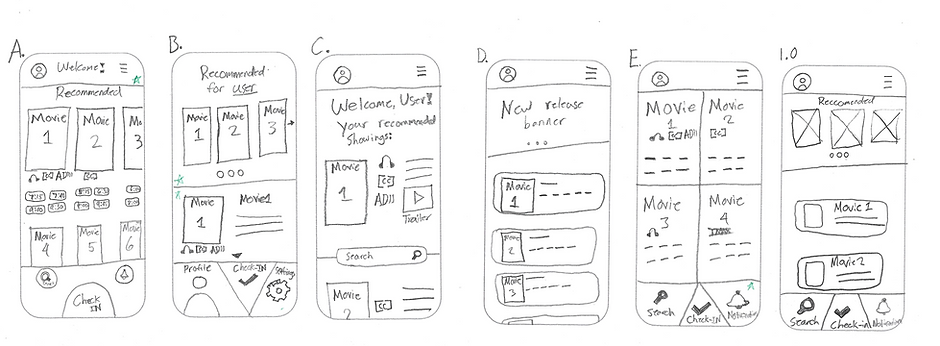


Low-fidelity prototype
The low-fidelity prototype we utilized in our usability study can be found here!
While initial usability study findings were overwhelmingly positive, excitement and interest primarily focused on the preferences and ability to send tickets, which became the focus of iterations past this point.

Findings and Insights
Our first usability study was conducted with our initial low-fi prototype, and concurrent to the study, the second version was built which included images, colors, and the first iteration of the onboarding process. This version can be found here.
Round 1 Findings
The "Recommended Movies" carousel is key to the user flow.
Ease of use is a commonly communicated value, aim to maintain.
Ensure the ability to send and recieve tickets remains an accessible point of entry to the user flow
Round 2 Findings
Participants were unhappy with the overall quality of the visual design.
The onboarding process has been received as a natural and welcome part of the user flow
Users generally expect the cancellation process to be automated if the ticket is not redeemed.
Refining the Design
Mockups
High-fidelity prototype
Accessibility
Mockups
Usability study 1
Using findings from the initial low fidelity mockup, I wanted to maintain the ease of use and layout, in this iteration, I aimed for pleasing visual design and large elements to emphasize accessibility.

Mockups
Usability study 2
Parallel to conducting my second usability study, I learned how to implement and iterate from design systems and how to use WCAG-friendly resources to help harmonize my design.
Feedback from this study, design critique sessions with peers, and my learnings on visual design led to this iteration, which I found to be more visually striking, cleaner, and neatly fit all elements of the design.


High-Fidelity Prototype
The final prototype became an easily scalable, complete user flow that I believe accomplished the mission of building an equitable, quick experience for all users.

Accessibility Considerations
An early iteration included text on images during the onboarding process. As my knowledge of accessibility guidelines grew, and I made considerations toward screen reader and text to speech technologies, this design evolved to dialog containers.
A core tenet of my design with this app was to study accessibility features in moviegoing, and implement those features as standard for those who benefit most. As a result, users can quickly know they’re considered in the process with no extra effort or research.
Adhering to World Wide Web Consortium (W3C) recommendations and Web Content Accessibility Guide (WCAG) guidelines were integral to my visual design. Using gestalt principles in combination with these visual accessibility principles made for an experience I am proud of.


Going forward
Takeaways
Next Steps
Takeaways
Impact
The impact of this project is, ironically, mostly on the designer. Being able to conduct user research, submit my work for critique by peers, and put together this case study has afforded me a generous amount of firsthand experience while reaffirming my desire to pursue and refine this skill set.
What I Learned
This project has been invaluable to me in terms of learning, everything from design tenets such as gestalt principles to working in a design system, and building accessible experiences through existing standards and good user research are important values I will carry with me into every design project I undertake.